A “100W” label does not tell you whether the quoted system can light a road through Chennai’s cloudy days, nor whether the battery, panel and controller are correctly sized. By checking the electrical rating, photometric evidence, energy reserve, installation method and acceptance tests, you can compare quotations without treating two unlike systems as equivalent.
Key takeaways
- Confirm that 100W means LED input power, not panel or battery capacity.
- Require panel wattage, battery voltage, ampere-hours and chemistry in writing.
- Ask for night-time runtime at the stated lighting schedule and location.
- Put pole, foundation, IP rating, cable routing and warranty in the order.
What does 100W mean on the quotation?
A quoted 100W normally means LED input power, not PV-module output or the complete system rating. If you searched for 100w solar street light for details before ordering in chennai, require the supplier to define the rating in writing.
- Require LED input power, delivered luminaire lumens, system efficacy in lumens per watt, colour temperature in kelvin, CRI, beam distribution, PV-module Pmax, battery voltage and capacity, controller rating, operating hours and dimming schedule.
- Ask whether the lumen figure comes from the finished luminaire or the LED package. Package lumens ignore driver, optic, thermal and enclosure losses; accept a photometric file or finished-luminaire test report instead.
- Require the intended road class, mounting height, pole spacing, maintained illuminance in lux, beam angle and uniformity at proposed road points. Reject an irradiation-area figure alone; a large claimed area can still contain dark road sections.
- Check the energy claim: an undimmed 100W luminaire running for 12 hours consumes 1.2 kWh before controller, wiring, battery and driver losses. The PV module and battery must cover those losses.
Compare quotations only after every supplier provides the same figures and a road-specific layout. A 100W label without photometric evidence describes a component load, not lighting performance.
Which solar panel, controller and battery figures must be specified?
Specify the complete energy chain, not just “100W panel”: panel type, rated wattage, operating voltage, open-circuit voltage, short-circuit current, physical dimensions, orientation, tilt, azimuth and mounting frame.
Ask for a Chennai-specific charging-time calculation based on the expected solar window. Require a drawing showing shadows from trees, buildings, parapets and utility lines; adequate nameplate wattage cannot overcome afternoon shading.
- Identify the controller as PWM or MPPT.
- Verify its battery-voltage range, PV-voltage margin, PV-current limit and load-current limit.
- Reject “10A” or “20A” unless those figures are matched to the actual panel and LED load, including cold-weather PV voltage.
For solar street light battery details in Chennai, require chemistry, nominal voltage, ampere-hours, watt-hours, permitted depth of discharge, cycle life, BMS functions, cell balancing, charge and discharge protection, operating-temperature range, replacement cost and warranty. A 24V, 50Ah battery stores 1.2kWh nominally; usable energy is lower after depth-of-discharge, conversion losses and cloudy-weather reserve.
| Battery option | Advantages | Risks and specification checks |
|---|---|---|
| LiFePO4 | Higher usable capacity; no electrolyte leakage; compact | Name the chemistry, BMS, balancing, temperature protection, cycle life and warranty |
| Lead-acid | Familiar and often easier to replace | Require ventilation, leakage protection and conservative usable capacity at the stated discharge depth |
Include the battery box, frame, cables and connectors in the drawing. A “complete set” quotation hides missing parts and makes charging performance impossible to verify.
How many hours will the light actually provide each night?
A 100W solar fitting does not promise 100W output for the whole night. Daily solar harvest and battery state determine how long it runs and how brightly it operates, so require a complete nightly schedule, not “two to three days backup.”
Ask the supplier to state:
- Full-brightness hours, every dimming level with its start time and duration, standby consumption in watts, low-battery voltage threshold and resulting output, and consecutive autonomy nights after cloudy weather.
- Whether “two to three days” means full power, scheduled dimming or reduced output after the voltage threshold.
- Motion-sensor detection angle, mounting height, trigger sensitivity, hold time, recovery time and false-trigger behaviour.
- Whether the quoted 8-metre range applies in every direction or only within a stated detection cone.
- The response when pedestrians, vehicles, vegetation or animals trigger the sensor.
Require a night demonstration that verifies switching, each dimming step and sensor response. Ask what happens when the battery reaches its reserve; a light that cuts out early is not delivering the advertised operating hours.
Do not compare the fitting directly with a 100W grid luminaire. A grid unit receives steady power, while solar output changes with harvest and battery charge. Finally, reject a claimed illumination area stated only in square metres: tie it to a photometric layout showing mounting height, pole spacing, maintained lux and uniformity.
What installation and weatherproofing details belong in the drawing?
A drawing must define the installation, not merely show a pole and panel. State pole height, arm outreach, luminaire tilt and aiming, panel dimensions, frame type, orientation, tilt, azimuth and clearance from trees, buildings, parapets or future obstructions.
- Show foundation dimensions, concrete details, anchor-bolt pattern, cable route, battery-box location, access method, connector sealing and the point where the luminaire and panel are bonded or earthed.
- Confirm the mounting interface by dimension: do not assume “50 mm” means pole diameter, spigot size or another fitting.
- Specify pole and bracket material or coating, protected fasteners, and treatment for every drilled hole and cut edge.
- Record the complete-luminaire protection: IP65 or IP66 under IEC 60529, the IK impact rating, UV resistance, corrosion protection, cable-gland specification and operating temperature range.
- Require panel shading clearance and an aiming mark tied to the approved photometric layout; mounting the luminaire level can miss the road’s target points.
- Require the nameplate or complete-luminaire datasheet to carry these markings. An LED-module rating or another model’s datasheet proves nothing.
These solar street light installation details matter in Chennai’s rain, heat and coastal salt air. Sealed entries, suitable coatings and protected fasteners prevent water ingress and corrosion from reaching the battery, controller or conductors. Add commissioning measurements for panel clearance, earth continuity, luminaire aiming and night illuminance.
How do you turn a quotation into a verifiable order?
A quotation becomes an order only when “complete set” is replaced by a numbered bill of materials. For 100 watt solar street light inclusions in Chennai, ask Shine Agencies or any supplier to identify every supplied part, its model number and quantity.
- LED luminaire; PV module or modules; battery and battery box; PWM or MPPT controller; mounting brackets; pole-top panel frame; luminaire arm; cables; glands; connectors; fasteners; earthing and lightning provisions; controller settings; commissioning; and warranty.
- Name these acceptance tests in the purchase order: nameplate verification, PV voltage and current checks, battery voltage and capacity checks, controller charging and load operation, night switching, dimming, illuminance at agreed road points, uniformity, insulation or earth continuity where applicable, workmanship inspection, and an as-built wiring diagram.
| Component | Standard or evidence to request | What it verifies |
|---|---|---|
| Complete luminaire | IS 10322 Part 1 and Part 2 Section 3, or IEC 60598-1 and IEC 60598-2-3; IEC 60529 for IP rating | Safety, road-lighting performance and enclosure protection |
| PV module | IS/IEC 61215 and IS/IEC 61730 test reports | Design qualification and module safety |
| Battery and controller | Named chemistry report, IEC 62619 where applicable, plus controller safety and EMC reports | Battery protection and electrical-component conformity |
Require each report to show the tested model, not merely “BIS compliant.” Put the agreed photometric layout, road points and warranty remedy in the order, then clarify who installs the system and replaces the battery after failure.
Related product
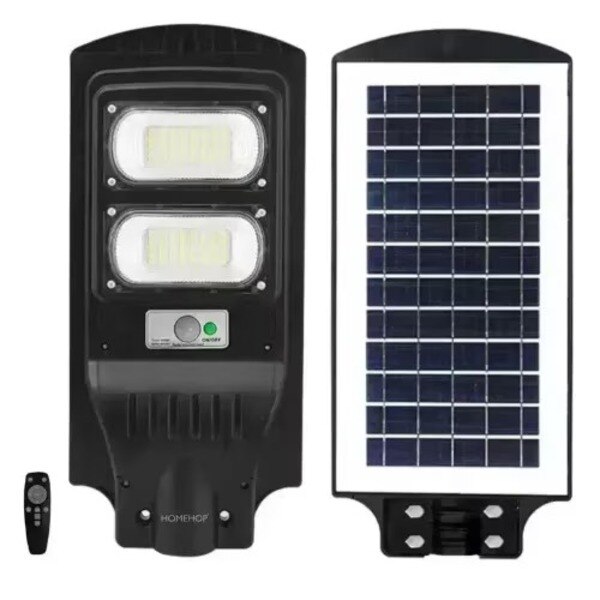
 | Solar street Light ₹3500 Radar (Motion) Sensor Detection Range: 8 Meters Max. Irradiation Area: 60-80 Sq. View product → |
Frequently asked questions
What does 100W mean on a solar street-light quotation?
Ask the supplier to state whether 100W refers to LED input power. Do not treat it as the PV-panel output, battery capacity or total system rating.
Which battery details should you request in Chennai?
Request the battery chemistry, nominal voltage, capacity in ampere-hours, usable energy, enclosure location, charging limits and replacement terms.
How many hours will a 100W solar street light operate each night?
Require a written runtime based on the lighting schedule, dimming levels, battery capacity, panel output and site conditions. A 100W label alone does not establish nightly hours.
What installation details should appear in the solar street-light drawing?
Check for pole height, arm length, foundation dimensions, anchor bolts, panel orientation, cable routing, earthing, access for maintenance and the fixture and enclosure IP ratings.
How can you make a solar street-light quotation verifiable?
Convert every promise into a line item with a stated figure, drawing, test document, acceptance check, warranty term and responsibility for civil and electrical work.
Keywords