


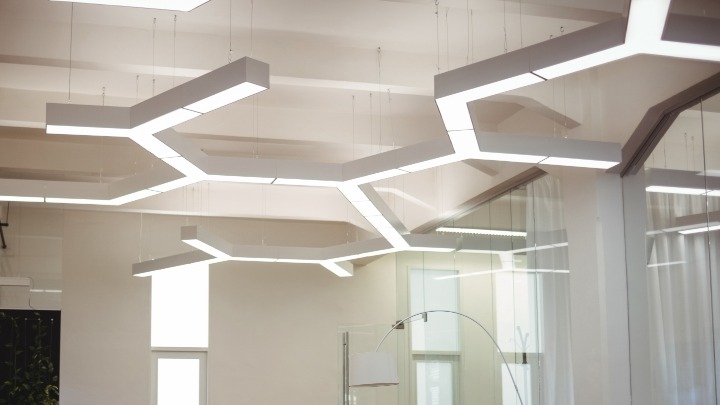
Office lighting influences screen visibility, concentration, visual comfort, safety, and the overall appearance of a workplace. Selecting Office Lighting Solutions in Guindy should therefore involve more than replacing fluorescent tubes with LED panels. The arrangement must respond to desk positions, computer use, meeting activities, natural daylight, and employee movement.
Guindy contains offices ranging from compact professional spaces to large corporate and industrial campuses. Each requires a lighting plan suited to its layout and working pattern.
Begin With Different Workplace Zones
An office is not one uniform environment. Reception areas, workstations, meeting rooms, cabins, corridors, and break areas perform different functions.
A practical plan may treat these zones separately:
- Workstations need comfortable task visibility.
- Meeting rooms require flexible lighting for discussions and presentations.
- Reception areas benefit from welcoming, layered illumination.
- Corridors require clear and safe navigation.
- Storage rooms need practical visibility without continuous operation.
- Break areas can use softer lighting than detailed work zones.
This zoned approach improves usability and makes control-based savings easier.
Reduce Glare Around Screens
Poorly positioned lights can reflect on monitors or create high contrast between the screen and surrounding surfaces. Employees may respond by changing posture, increasing screen brightness, or switching off nearby fixtures.
Glare control involves fixture optics, placement, mounting height, surface reflectance, and workstation orientation. Diffused luminaires may help, but the complete layout must still be assessed.
Direct sunlight on screens can create similar problems. Blinds or shading may be needed where daylight becomes excessive.
Choose a Balanced Colour Temperature
Colour temperature shapes the atmosphere of the office. Neutral white is commonly used in work areas because it provides a balanced visual environment. Warmer tones may suit lounges or hospitality-oriented reception spaces, while very cool lighting can appear harsh if used without careful design.
Consistency matters. Mixing noticeably different colour temperatures within one visible area can make the space look unplanned.
Colour rendering should also be considered where teams evaluate products, fabrics, printed materials, designs, or finishes.
Use Daylight Without Creating Discomfort
Natural daylight can reduce dependence on artificial lighting and improve the character of an office. However, uncontrolled daylight can produce glare and uneven brightness.
Daylight-responsive controls can dim or switch suitable fixtures near windows when sufficient natural light is available. Interior zones may remain illuminated independently.
Window orientation, seasonal sun angles, blinds, glass type, and furniture arrangement should be considered during planning.
Introduce Appropriate Controls
Controls can reduce energy consumption without compromising usability.
Options include:
- Occupancy sensors
- Zonal switches
- Dimming systems
- Timers
- Daylight sensors
- Scene controls for meeting rooms
Meeting rooms and cabins that remain unoccupied for long periods are suitable candidates for occupancy-based operation. Open offices may need more carefully defined control zones to avoid distracting switching.
Plan for Maintenance and Future Changes
Office layouts evolve as teams grow or departments move. A rigid lighting arrangement may become ineffective when desks and partitions are repositioned.
Modular fixtures and sensibly grouped circuits can make future adjustments easier. Drivers, sensors, and replacement components should remain accessible without major ceiling disturbance.
Shine Agencies supports businesses comparing efficient lighting products for different office applications. For workplaces in Guindy, Chennai, the best solution combines task visibility, glare control, suitable colour quality, flexible controls, and maintainable equipment. Energy efficiency matters, but it should be achieved while preserving a comfortable and functional environment for the people using the space every day.