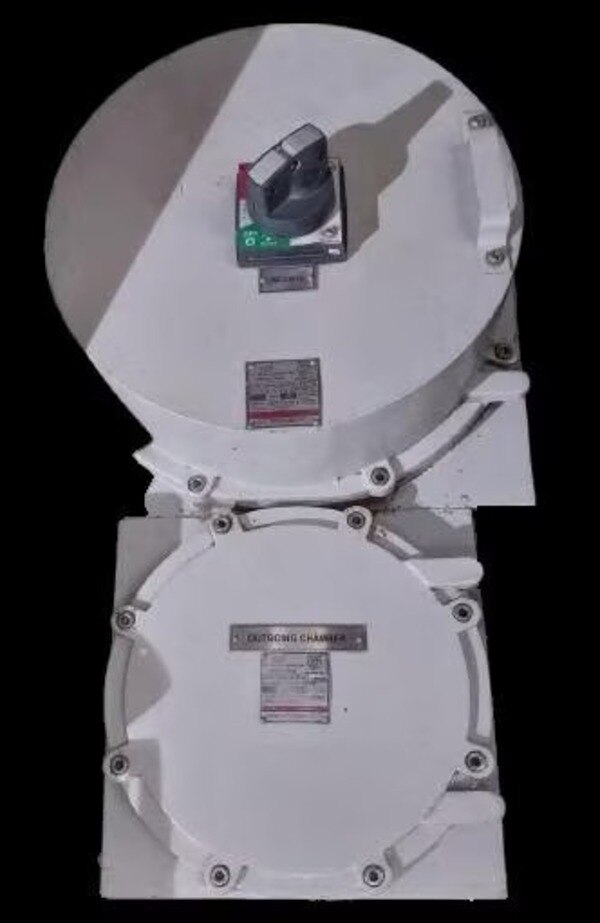
An FLP MCCB is not simply an ordinary breaker with a weatherproof box: the breaker, flame-proof enclosure, operating mechanism, cable entries and certification must work as one specified assembly. By the end, you will know which technical details to request, which parts to count, and how to check that the quoted equipment suits your hazardous-area installation.
Key takeaways
- Request the MCCB rating, breaking capacity, poles and accessories on the quotation.
- Confirm the Ex d marking matches your hazardous area, gas group and temperature class.
- Specify enclosure material, IP rating, cable entries and outdoor protection before ordering.
- Send a Chennai RFQ listing the MCCB, enclosure, certification and installation requirements.
What an FLP MCCB assembly actually includes
The MCCB is the circuit-protection device; the Ex d enclosure contains it and provides the external operating arrangement. An MCCB alone is not automatically flame-proof. Ask what comes with an FLP MCCB before treating the quotation as a complete assembly.
- MCCB, with manufacturer, model and rating
- Ex d enclosure
- Baseplate or internal mounting hardware
- External operating handle and shaft, where fitted
- Gland plates
- Cable glands and stopping plugs
- Line and load terminals
- Earth studs and internal earth hardware
- Internal wiring and cable lugs
- Seals or gaskets
- Cover bolts and keys
- Wiring diagrams, certificate, installation instructions and inspection documents
These items are not automatically included: auxiliary contacts, alarm contacts, shunt trip, undervoltage release, motor operator, rotary handle, surge protection, cable lugs and outgoing wiring. Each one affects space, wiring and price.
Ask whether the quoted catalogue number identifies a complete certified MCCB-and-enclosure assembly or an empty enclosure prepared for a separately specified MCCB. Require a signed bill of materials listing every included and excluded item. “Standard accessories” is not a bill of materials.
A missing gland, plug or operating shaft can leave a correctly rated breaker unusable or compromise the intended certified configuration.
MCCB specifications that must appear on the quotation
The quotation must identify the manufacturer, exact MCCB model, frame size, number of poles, rated current In, operational voltage Ue, insulation voltage Ui, frequency, Icu and relevant Ics values, and compliance with IEC 60947-2.
- State the trip-unit technology and actual adjustment ranges: long-time overload pickup and delay, plus instantaneous magnetic pickup and delay where adjustable. Do not accept only “250 A MCCB.”
- List every accessory and the space it occupies, including auxiliary or alarm contacts, shunt trip, undervoltage release and motor operator.
- Confirm breaker heat dissipation, enclosure temperature rise and suitability at the declared ambient temperature.
- Show coordination or discrimination with the upstream protective device, including settings and time-current data.
| Trip unit | Protection method | Quotation detail |
|---|---|---|
| Thermal-magnetic | Thermal element protects against overload; magnetic element trips on short circuit | State whether long-time and instantaneous settings are fixed or adjustable |
| Electronic | Sensors and electronics calculate overload and short-circuit conditions | State long-time, short-time, instantaneous and ground-fault ranges, delays and testing method |
The breaker’s rating is not the site’s prospective fault current; compare Icu and Ics with the measured or calculated fault level at the installation point. Require written confirmation that the exact MCCB, accessories and Ex d enclosure combination was tested or certified together, not assembled from separately approved parts.
These are core FLP MCCB specifications and accessories.
How to match the Ex marking to the hazardous area
1. Match the marking to the site dossier, not to the words “FLP.” Record whether the area is Zone 1 or Zone 2, the gas or vapour handled, gas group, required equipment protection level (EPL), temperature class and ambient-temperature range.
2. Check every part of the marking. Ex d IIA or Ex d IIB alone does not establish suitability: an IIC location requires equipment marked for IIC, and the temperature class must not exceed the gas ignition limit.
A gas-area enclosure must not be assumed suitable for dust hazards such as Zone 21 or Zone 22.
3. Confirm the protection concept. Ex d contains an internal explosion through flamepaths; Ex e uses increased safety to prevent arcs, sparks and excessive temperature; Ex p relies on pressurisation; Ex t protects against dust ignition. These are not interchangeable flame proof mccb enclosure details.
4. Treat ingress protection separately. IP66, referenced through IS/IEC 60529, addresses dust and water ingress, while IS/IEC 60079-1 addresses Ex d construction, including flamepaths and fasteners. Neither standard substitutes for the other.
5. Request the exact marking-plate photograph, certificate number and complete certificate schedule. Check its permitted ambient range, gas group, temperature class, EPL and approved cable entries, glands and stopping plugs before ordering.
Enclosure, cable-entry and outdoor-service details to confirm
Confirm length, width, depth, usable internal clearance, baseplate layout, door or cover opening, weight, mounting-hole pattern, cable-entry position and usable gland-plate area before approving the enclosure. These dimensions expose both fit problems and MCCB heat-dissipation limits.
- Specify thread type, metric or NPT size, entry count, cable outside-diameter range, armoured or unarmoured treatment, certified Ex d glands, barrier glands where required, stopping plugs, reducers, lugs, and drain or breather provisions.
- List cable glands and plugs as separate line items. An IP66 enclosure does not remain an IP66-certified installed assembly after improvised entries are fitted.
State indoor or outdoor service, Chennai monsoon rain, sunlight, salt air and washdown exposure. Confirm corrosion-resistant material or coating, stainless hardware, gasket material, condensation control, and whether a sunshade or additional coating is permitted; flameproof certification alone does not protect against coastal corrosion.
| Option | Cost and access | Heat, maintenance and suitability |
|---|---|---|
| Standard weatherproof MCCB box | Lowest cost; easiest access | Good heat access, but unsuitable for hazardous areas |
| Ex e enclosure | Moderate cost; restricted modification | Lower ignition risk, but not Ex d flame containment |
| Certified flame-proof distribution board | Highest cost; controlled access | Certified for specified hazardous areas; heavier and slower to maintain |
Installation, certification and maintenance checks
Protect the certificate during installation: preserve every flame-path surface and fit the specified cover bolts with the required thread engagement. Do not paint, file, grease, drill or damage a flame path unless the certificate and manufacturer’s instructions expressly allow it. Complete internal and external earthing and bonding.
Isolate, lock out and prove dead before opening, with approval from the site electrical engineer and a competent hazardous-area inspection authority.
Request these documents before release:
- Ex certificate number and schedule, marking-plate photograph, dimensional drawing, wiring diagram, signed bill of materials and installation manual
- Inspection certificate and routine or type-test evidence where supplied
- Confirmation that the certificate covers the exact MCCB, enclosure, glands, plugs and accessories ordered; separately sourced parts can invalidate the intended Ex configuration
Check the delivered assembly against this list:
| Check | What to verify | Failure to catch |
|---|---|---|
| Nameplate | Matches the purchase order; breaker identification or serial details agree | Wrong certified configuration |
| Contents | Count every listed accessory, seal and bolt | Missing parts delay installation |
| Entries | Unused entries are correctly plugged; glands are tight | Loss of flameproof or IP protection |
| Condition | Earth continuity, corrosion, cover-joint damage and unauthorised drilling | Unsafe or invalid enclosure |
Do not open the enclosure for maintenance without repeating the isolation and proving-dead process. Record inspections and reject any modified flame path.
The Chennai FLP MCCB order checklist and RFQ format
1.
Send this FLP MCCB order checklist in Chennai with the RFQ: site address; hazardous-area drawing; Zone 1 or Zone 2; gas or vapour; gas group; temperature class; equipment protection level; ambient temperature; indoor or outdoor exposure; supply voltage and frequency; pole count; current rating; Icu and Ics; trip-unit type and settings; incoming and outgoing cable sizes and construction; entry threads; gland schedule; enclosure material and dimensions; IP requirement; internal and external earthing; accessories; delivery deadline; GST, purchase-order, tender and inspection documents.
2. Request separate priced RFQ lines for MCCB; enclosure; operating mechanism; gland plates; certified glands; stopping plugs; terminals; earth hardware; accessories; internal wiring; certification documents; drawings; inspection; commissioning; freight; and site measurement. State the breaker brand, exact model, frame size, Ue, In, IEC 60947-2 basis and adjustment ranges.
Ask whether covers, bolts, glands, MCCBs and trip units match the certified assembly.
3. Ask for the certificate number, marking plate, certificate schedule, dimensional drawing, wiring diagram, bill of materials and inspection evidence. Confirm the certificate covers the exact MCCB, enclosure, glands, plugs and accessories.
4. Price rises with custom gland plates, breaker brand, electronic trip units, certification paperwork, inspection, Chennai transport and short lead time. Shine Agencies can quote the complete bill of materials and documentation as separate, verifiable lines rather than a vague “FLP MCCB” package.
Related product
 | Flame Proof industrial Lighting PRODUCT : CAT NO.: MCDB / 186 , RCP /215 ENCLOSURE : FLAME PROOF (Ex –d ) , G a s G r o u p I I A , I I B As per IS/IEC 60079-1 : 2014 PROTECTION :... View product → |
Frequently asked questions
What comes with an FLP MCCB?
A complete assembly can include the MCCB, Ex d enclosure, external operating handle, internal mounting plate, busbars or links, cable glands, terminals, earth studs, blanking plugs and certification documents. Ask the supplier to list every included and excluded part.
Which MCCB specifications must appear on the quotation?
Request the rated current, voltage, frequency, number of poles, short-circuit breaking capacity, trip-unit type, adjustable settings, isolation suitability, terminal arrangement and accessory details such as undervoltage release, shunt trip or auxiliary contacts.
How do you match an Ex marking to a hazardous area?
Compare the enclosure marking with the site zone, gas or dust classification, equipment group, protection concept and temperature class. Confirm the marking on the certificate and nameplate rather than relying on the phrase flame-proof.
What FLP MCCB enclosure and outdoor details should you confirm?
Confirm enclosure material, internal dimensions, IP rating, corrosion protection, cable-entry size and direction, certified cable glands, drain or breather arrangements, external handle operation and suitability for rain, heat and coastal corrosion.
What belongs in an FLP MCCB order checklist for Chennai?
Include the site location and hazardous-area classification, electrical ratings, enclosure dimensions, cable schedule, entry requirements, Ex certification, inspection documents, installation scope, delivery terms and a list of included accessories and exclusions.
Keywords