Choosing between a well glass and a bulkhead starts with the hazardous-area certificate, not the shape of the fitting. By checking the zone, gas or dust group, temperature limit, mounting conditions and installation hardware, you can identify which form suits your Chennai site—or discover that neither option is certified for the hazard.
Key takeaways
- Confirm the hazardous-area zone before choosing a luminaire shape.
- Read T6 as a maximum surface-temperature class, not a brightness rating.
- Request certification, marking details, batch information and installation instructions.
- Choose well glass for coverage; choose bulkhead for compact, low-clearance locations.
What actually differs between a well glass and a bulkhead?
A well glass and a bulkhead describe luminaire forms, not explosion-protection methods. A well glass places a lamp or LED source behind a glass globe and protective guard; a bulkhead uses a compact, low-profile housing with a glass or polymer diffuser.
| Form | Light and physical effect | Maintenance and heat |
|---|---|---|
| Well glass | Broad, near-omnidirectional light; the globe and guard project farther, creating more snagging and obstruction risk | Guard and glass resist impact; replaceable lamps require correct wattage, holder and relamping access, while heat must escape around the globe |
| Bulkhead | More controlled distribution; the shallow body reduces projection in corridors and low-clearance spaces, but nearby structures can create shadows | Diffuser material determines impact resistance; sealed LED construction limits routine access and relies on housing and driver heat dissipation |
Mounting height changes the decision: a high well glass can spread light around tanks and pumps, while a low bulkhead can reduce glare and obstruction in walkways. Check photometric data rather than assuming either form is better for a well glass or bulkhead light for industrial areas.
An ordinary industrial well glass or bulkhead is not hazardous-area suitable because it has metal, glass or a robust enclosure. Confirm an Ex d, Ex e, Ex ec, Ex tb or combined marking and its certificate. That is the central flame proof well glass comparison.
In Ex d equipment, never file, drill or repaint mating flamepaths, or fit unauthorised fasteners, glass, covers or other replacement parts; those changes can destroy containment.
Match the fitting to the hazardous-area zone before comparing shapes
Start with the hazardous-area drawing and process assessment, not the luminaire catalogue. The zone records how often an explosive atmosphere exists; a well glass or bulkhead light for industrial areas is acceptable only when its complete marking and certificate cover that condition.
1. For gas, match the fitting to the zone and required equipment-protection level: Zone 0 requires equipment for continuous or long-duration vapour exposure, Zone 1 for vapour likely during normal operation, and Zone 2 for vapour unlikely in normal operation and brief if it occurs. Confirm IIA, IIB or IIC and the required EPL.
An IIA or T4 fitting is not automatically suitable for IIC or T6.
2. For combustible dust, use dust-rated equipment: Zone 20 covers continuous or frequent dust clouds, Zone 21 covers dust likely during normal operation, and Zone 22 covers dust unlikely in normal operation and brief if present. Look for Ex t and the specified dust group, such as IIIC.
Gas-only Ex d does not establish dust suitability.
3. Apply that test to tank farms, solvent stores, paint shops, refineries, oil terminals, chemical plants and workshops. Identify whether the release is vapour or dust, record its frequency, then compare every part of the proposed marking with the assessment.
4. Reject both forms when the certificate does not cover the zone, gas or dust group, EPL, or temperature requirement. Shape cannot correct a classification mismatch.
Neither form wins automatically among hazardous area lighting options in Chennai; certification decides first.
Read T6, maximum surface temperature and dust markings correctly
T6 means a gas-rated luminaire has a maximum surface temperature of 85°C under its specified test conditions. Do not confuse this with the 85°C dust-surface marking in a bulkhead marking such as Ex tb/tc IIIC T85°C Db/Dc: the first is a gas temperature class, while the second states the permitted dust surface temperature.
1. Match the complete marking to the exact configuration, hazardous-area zone and equipment-protection level you are buying. Confirm the gas group—IIA, IIB or IIC—or the dust group, such as IIIC, because gas and dust classifications are not interchangeable.
2. Check the permitted ambient-temperature range, LED-driver heat, enclosure heat dissipation and any nearby hot process surface. A driver inside a poorly cooled housing can push the actual surface temperature beyond the declared limit.
3. Assess dust thickness and cleaning frequency. A combustible dust layer insulates the enclosure, traps heat and can raise its surface temperature, so a clean laboratory result does not settle a dusty site’s risk.
4. Treat IP66 as an ingress rating for dust and water, not explosion protection. It does not contain an internal explosion or prove hazardous-area approval.
For hazardous area lighting options in Chennai, coastal humidity and process corrosion add separate checks: enclosure alloy, coating system, exposed stainless-steel grade, gasket compatibility and permitted ambient range. An Ex certificate does not guarantee marine-chloride durability, and corrosion resistance does not replace certification. That distinction matters in any flame proof well glass comparison.
What documents and installation details should you verify in Chennai?
Before approving a quotation, obtain the hazardous-area drawing and match the luminaire to the site classification, not its catalogue title. For a flame proof well glass versus bulkhead light in Chennai decision, verify the complete marking and certificate for the exact configuration.
- Record the zone, gas group IIA, IIB or IIC, or dust group, plus T-class or maximum surface temperature.
- Confirm the permitted ambient-temperature range, mounting orientation, supply voltage, LED wattage, driver model and driver temperature limits.
- Request photometric data, cable-entry size and thread, cable construction, gland type, stopping-plug type and terminal-block details.
- Obtain the certificate number, complete certificate copy, installation, inspection and maintenance instructions, and any PESO approval or statutory documentation required for the facility.
Check the bulkhead’s stated Ex db IIA/IIB and Ex tb/tc IIIC T85°C Db/Dc markings against its certificate. The supplied catalogue line does not show a complete certificate reference, validity-check method or whether every marking applies to one configuration. Do not accept “flameproof” or “industrial” as evidence.
| Installation item | What to verify | Why it matters |
|---|---|---|
| Entry system | Gland, blanking plug, terminal block and conduit match the cable, thread, Ex protection and environment | These parts form the protection system |
| Certification | Certificate covers the selected zone, group, temperature and orientation | A different configuration can invalidate the marking |
Shine Agencies is useful as an industrial well glass light dealer in Chennai when you need to compare a certified well glass, bulkhead, cable-entry hardware and documentation; require the certificate, not a verbal assurance.
Related products
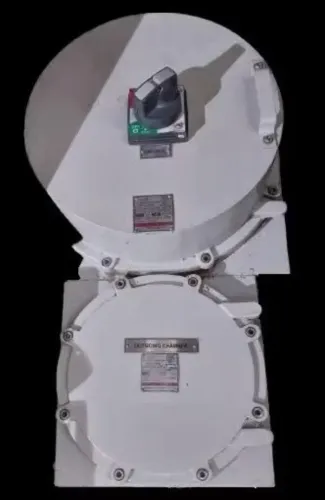
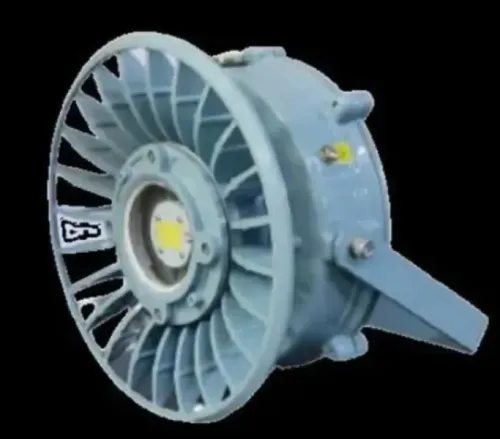
 | Flame Proof industrial Lighting Flame Proof Well glass Fitting PRODUCT : CAT. NO. – WG/1240 ENCLOSURE : FLAME PROOF (Ex –d ), Gas Group IIA , IIB , IIC As per IS/IEC 60079-1 : 2014 PROTECTION : WEATHER PROOF IP –... View product → |
 | Flame Proof industrial Lighting 40watts led flame proof well glass fitting ₹14830 Flame proof Gas Group Group II equipment is subdivided into three subgroups. View product → |
Choose the form by light distribution, maintenance and site geometry
Choose a well glass when wide, multi-directional coverage is valuable around tanks, pumps, valves and open process equipment. Choose a bulkhead when a compact, low-projection body suits corridors, low-clearance walkways or areas exposed to snagging.
| Option | Distribution and geometry | Maintenance implications |
|---|---|---|
| Well glass | Broad, near-omnidirectional light around equipment | Check guard, globe, heat output, relamping access and replacement lamps |
| Bulkhead | Controlled beam with less glare, projection and shadow | Check inspection access, cleaning frequency, LED-driver life and replacement parts |
Compare the actual lighting task rather than assuming one form is safer. Check required illuminance, mounting height, beam distribution, emergency-lighting needs, obstruction risk and access for inspection. Photometric data should decide whether the flame proof well glass versus bulkhead light in Chennai illuminates valves and pump faces without wasting light above them.
An LED retrofit lamp cannot be inserted into an existing flameproof luminaire unless the certified combination and manufacturer’s instructions explicitly permit it. An incompatible lamp or driver can invalidate the protection, alter heat output and create a maintenance failure.
For a well glass or bulkhead light for industrial areas, make the final checks:
- Confirm cleaning frequency and replacement-part availability.
- Verify that the complete certificate matches the zone, gas or dust group, temperature requirement and installation system.
- Reject either form if its mounting arrangement or photometry leaves critical work surfaces dark.
Neither well glass nor bulkhead wins automatically; select the fitting whose complete certificate matches the hazard, then use photometric and maintenance data to choose the shape.
Frequently asked questions
What is the difference between a well glass and a bulkhead light?
A well glass uses a globe and protective guard around the light source, while a bulkhead uses a compact, low-profile housing with a diffuser.
Should you choose a well glass or bulkhead light by shape first?
No. Confirm the hazardous-area zone and required explosion-protection method before comparing the two forms.
What does T6 mean on hazardous-area lighting?
T6 identifies a maximum surface-temperature class. It is not a measure of brightness or power consumption.
What should you verify before installing hazardous-area lighting in Chennai?
Check the certification, complete hazardous-area marking, product documents, installation instructions, cable entries, glands and mounting details.
Related products
 | FLP indutrial lighting BULKHEAD IIA & IIB UP TO 45 W LED PRODUCT : CAT. NO.- BH/124 ENCLOSURE : FLAME PROOF (Ex –d) , G a s G r o u p I I A , I I B As per IS/IEC 60079-1: 2014 AREA & TEMP. View product → |
 | Flame Proof industrial Lighting FLP-WP WELL GLASS FITTING UPTO 45 W LED (FLAT GLASS PRODUCT : CAT.NO. – WG/1240 ENCLOSURE : FLAME PROOF (Ex –d ), Ga s G r o u p I I A , I I B , I I C As per IS/IEC 60079-1 : 2014 PROTECTION : WEATHER... View product → |
Keywords